
Glynn Vivian Art Gallery, Swansea
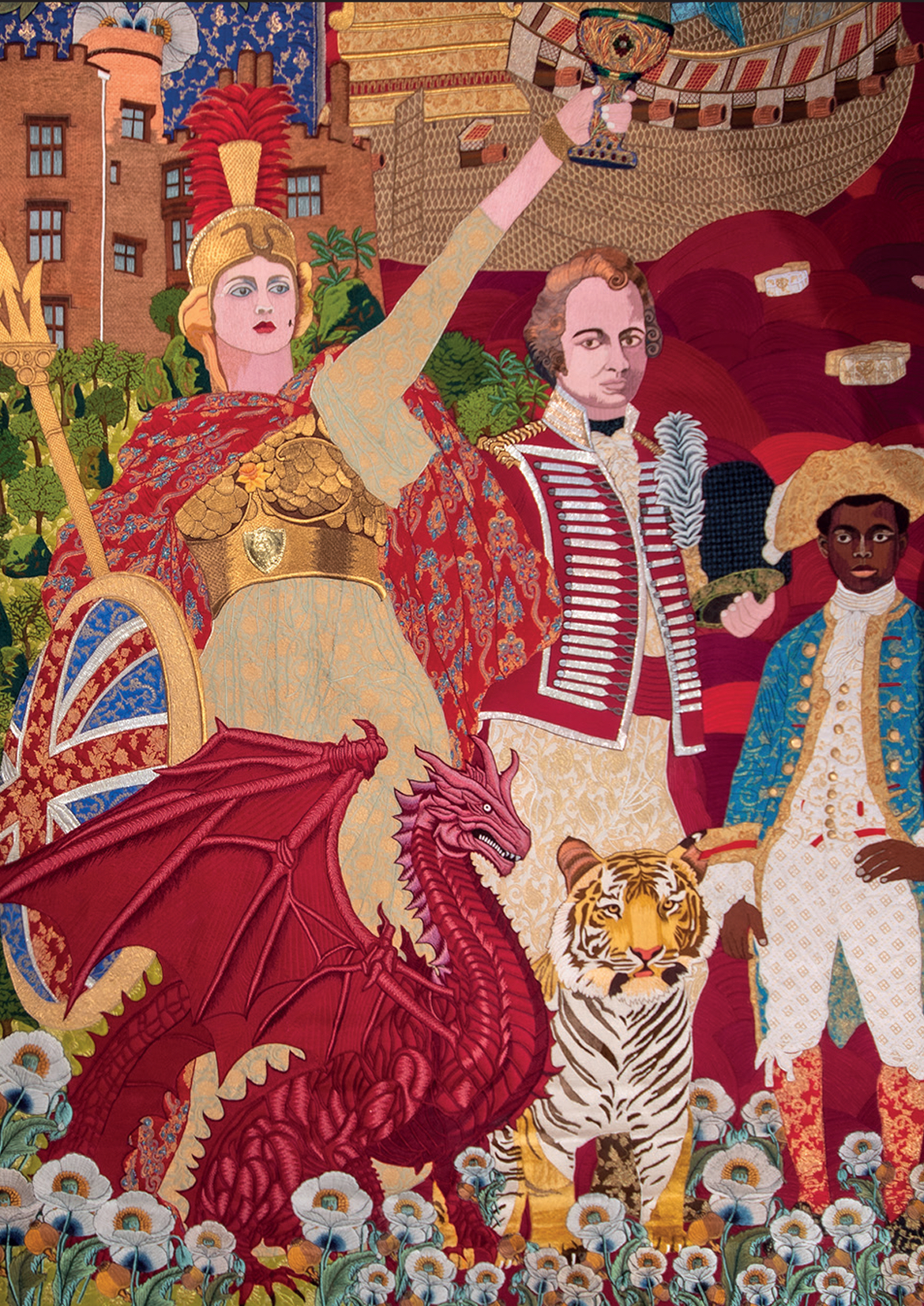
Glynn Vivian Art Gallery is delighted to present Tigers & Dragons: India and Wales in Britain, an extraordinary exhibition that delves into the deep-rooted connections between the Indian Subcontinent and Wales.
Co-curated with Dr. Zehra Jumabhoy.
Tigers & Dragons explores the iconography of South Asian nations and Wales; examining how they have imagined themselves—or been imagined—over the centuries. If India was the Jewel in the Imperial Crown, could we argue that Wales was England’s first colony? As Wales struggles for its identity within ‘British-ness’, it is timely to re-assess the way it contributed to, benefited from and, even, suffered for Britain’s Imperial ambitions. The show investigates the British Empire’s legacy and its continuing relevance for Welsh identity as well as for India, Pakistan and Bangladesh.
The exhibition features over 100 artworks – paintings, photographs, performances, textiles, sculptural installations and new media – by roughly 70 artists from Wales, England, India and Pakistan. Historic and contemporary loans are drawn from private and public collections, including National Museum Cardiff, National Library Wales, National Trust’s Powis Castle and the Bristol Museum’s British Empire & Commonwealth Collection. Loans are supported by the Weston Loan Programme with Art Fund. Created by the Garfield Weston Foundation and Art Fund, the Weston Loan Programme is the first ever UK-wide funding scheme to enable smaller and local authority museums to borrow works of art and artefacts from national collections.
The exhibition traces the social and political complexities of the India-Wales relationship. Highlighting Imperial connections (through war, trade and language), it also probes other equivalences. If Wales is England’s Internal Colony, as India was once an External one, what can we learn from comparing the two? The exhibition considers the visual symbolism of both Imperial subjugation (the Indian Tiger dominated by the Lion of Britannia; the Red Welsh Dragon pitted against the White Dragon of England) and national awakening. Just as Indian independence movements were inspired by ideas of Mother India, similarly Welsh nationalism clings to the skirts of Mother Wales.
Artists Included:
Adeela Suleman
Aisha Khalid
Alia Syed
Amna Walayat
Anwar Shemza (1928-1985)
Anju Dodiya
Alfred Janes (1911-1999)
Arthur Giardelli (1911-2009)
Arthur William Devis (1763-1822)
Bedwyr Williams
Bushra Waqas Khan
Bhupen Khakhar (1934-2003)
Christopher Williams (1873-1934)
Ceri Richards (1903-1971)
Daniel Trivedy
David Alesworth
Faiza Butt
Frank Brangwyn (1867-1956)
Frank Nowlan (1835-1919)
Imran Qureshi
Iwan Bala
JMW Turner (1775-1851)
Kathryn Campbell Dodd
Kathryn Ashill
Laura Ford
Lauren Heckler
Liaqat Rasul
Muzzumil Ruheel
Nasia Sarwar
Nasma Ali
Nathaniel Dance-Holland (1735-1811)
Nikhil Chopra
Nilima Sheikh
Noor Ali Chagani
Peter Finnemore
Paul Davies (1947-1993)
Pushpamala N.
Rashid Rana
Raja Deen Dayal (c.1844-1905)
Reena Saini Kallat
Rummana Hussain (1952-1999)
Richard Glynn Vivian, Founder of the Glynn Vivian Art Gallery, Swansea (1835-1910)
Risham Hosain Syed
Shahzia Sikander
Shanzay Subzwari
Tarun Bhartiya (1970-2025)
Waswo X Waswo
Zahoor ul-Akhlaq (1941-1999)
Zarina Hashmi (1937-2020)
Historic and Contemporary loans from:
National Library Wales, Aberystwyth
National Trust: Powis Castle
Bristol Art Museums and Archives (including the British Empire & Commonwealth Collection)
Amgueddfa Cymru – Museum Wales
Taimur Hassan Collection
Collection of Charles Moore, London
Collection of Kajoli Khanna, London
Supporting Galleries:
Grosvenor Gallery, London
Canvas Gallery, Karachi, Pakistan
Chatterjee & Lal, Mumbai, India
Chemould Prescott Road, Mumbai, India
 Kathryn Campbell Dodd